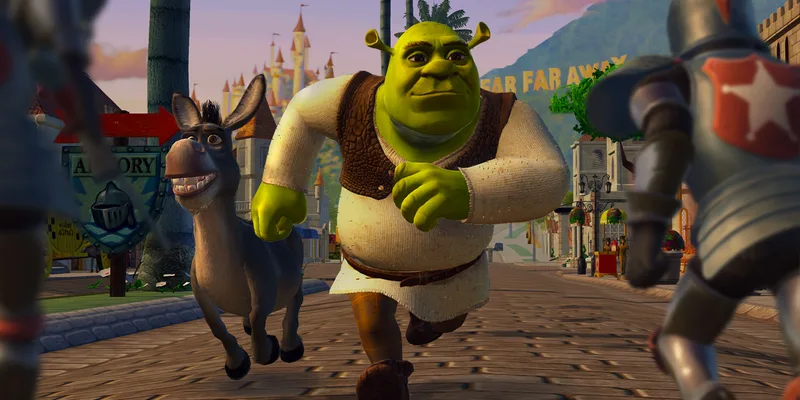
- Primary keyword: DreamWorks Shrek 2 Remastered differences from original remain unconfirmed.
- Original foundation: The console game combines co-op combat, character swapping, missions, and mini-games.
- Likely priorities: A remaster should improve controls, performance, camera behavior, and co-op stability.
- Feature boundary: No official remaster feature list or release specification is established here.
- Best comparison method: Separate confirmed original traits from reasonable remaster expectations.
DreamWorks Shrek 2 Remastered differences from original
The phrase DreamWorks Shrek 2 Remastered differences from original describes a comparison rather than a confirmed feature list. The available material focuses on the original Shrek 2 console game, including its story structure, playable cast, co-op design, optional missions, upgrades, mini-games, and technical problems. It does not establish an official remaster specification.
That distinction matters. A reliable wiki comparison should not present imagined resolution upgrades, new platforms, restored scenes, or release details as confirmed facts. Instead, this guide identifies what defines the original game and explains which areas would create the clearest difference if a remastered edition were formally announced.
No confirmed remaster feature list is established by the available material. Treat visual upgrades, new content, platform plans, and release timing as unconfirmed until an official announcement provides those details.
What the original game actually offers
The original console version retells the film through a series of playable detours. Shrek and his companions travel through areas such as the swamp, the forest, Far Far Away, farms, mines, and the Fairy Godmother’s factory. These locations expand the movie’s plot instead of simply repeating every scene in the same order.
The main structure is built around a small team of characters. Players can switch between four characters during many stages, with each character offering a different combat or traversal role. Shrek can handle heavy objects, Fiona can use time-slowing effects, Donkey has a powerful kick, and Little Red uses ranged explosive apples.
| Original feature | How it works | Why it matters in a remaster |
|---|---|---|
| Character swapping | Switch between four playable characters in team-based stages | The system should remain responsive and easy to read |
| Character abilities | Each hero has distinct attacks, movement traits, and special skills | Clearer effects could make every character feel more useful |
| Story detours | Levels expand or rearrange events from the movie | Additional scenes should preserve the game’s playful identity |
| Mission objectives | Stages include mandatory and optional tasks | Better tracking would make completion goals easier to follow |
| Hero Time | Character-focused mini-games appear after selected levels | A remaster could improve input response and local multiplayer clarity |
| Upgrade shops | Coins can purchase health, attack, and coin-related upgrades | Progression should remain understandable without becoming intrusive |
The most important comparison principle
A remaster should preserve the original game’s identity rather than turn it into a different genre. The game’s appeal comes from accessible action, family-friendly co-op, recognizable Shrek humor, and varied objectives. A faster camera or sharper image would help, but those changes should support the existing design.
Original gameplay systems worth preserving
The original game is more than a movie tie-in. Its strongest idea is the shared adventure format, where several characters contribute different abilities. This creates a natural reason to switch heroes instead of treating the cast as cosmetic alternatives.
Combat is simple by modern standards. Characters generally attack, jump, and activate a special ability. That simplicity makes the game approachable, but the source material also describes moments where movement feels slow, actions have noticeable delays, and companion-controlled characters can become confused or stuck.
Keep the simple control scheme, but improve response time, camera behavior, companion navigation, and collision handling. These changes would modernize the experience without removing its accessible design.
Shrek
Heavy interaction specialist. His strength is useful for lifting large crates and handling stunned enemies.
Fiona
Utility-focused hero. Her time-slowing ability supports careful movement and timing-based encounters.
Donkey
Close-range attacker. His kick can launch enemies and gives him a distinct crowd-control role.
Little Red
Ranged option. Rotten explosive apples provide distance-based attacks and unusual puzzle solutions.
Co-op design and local play
The original game is designed around cooperation. Players can share control during regular stages, while certain Hero Time sections give individual characters an opportunity to shine. This structure helps explain why the game remains memorable for players who experienced it with siblings or friends.
A remaster should therefore treat local co-op as a core feature, not an optional extra. Shared-screen readability, stable character positioning, and reliable respawning would matter more than adding unrelated online systems.
| Gameplay area | Original characteristic | Sensible remaster goal |
|---|---|---|
| Combat | Simple attacks and special abilities | Faster input response and clearer hit feedback |
| Exploration | Small hub spaces and linear stage routes | Smoother movement without removing stage structure |
| Co-op | Multiple characters operate on one screen | Stable camera framing and fewer separation problems |
| Companion AI | Controlled characters may fall, stall, or lose direction | Improved navigation and recovery behavior |
| Mini-games | Hero Time and activity-based challenges break up combat | Consistent controls and clearer instructions |
| Boss fights | Several encounters can become unexpectedly difficult | Fairer telegraphs while preserving challenge |
What should not be removed
The game’s odd detours are part of its charm. Gathering unusual ingredients, guiding transformed animals, completing chores, helping familiar fairy-tale characters, and dealing with chaotic Far Far Away events all give the adaptation its own personality.
A remaster that cuts these sections in favor of a direct movie retelling would lose one of the original’s strongest advantages. The better approach would be to keep the detours and improve pacing, loading, readability, and technical reliability around them.
Step-by-step comparison method
Use the following process when evaluating any future remaster announcement, trailer, or hands-on footage. It separates confirmed differences from assumptions and keeps the comparison focused on the original game’s actual systems.
Compare feature categories instead of relying on screenshots alone. A brighter image may look different, but improved controls, co-op behavior, mission tracking, and performance have a greater effect on the play experience.
Confirm the announcement
Check whether the remaster is officially announced and identify the publisher, developer, platforms, and stated release window. Do not treat rumors or fan speculation as confirmed features.
Record the original structure
List the original game’s playable characters, level sequence, mission types, Hero Time sections, upgrade system, co-op support, and bonus activities.
Separate visual changes
Compare image quality, lighting, character models, environment textures, effects, menus, and cutscenes. Keep visual observations separate from gameplay changes.
Test functional improvements
Examine loading behavior, frame stability, collision, camera movement, companion AI, save handling, controller response, and local multiplayer reliability.
Check content changes
Note any restored scenes, new challenges, altered dialogue, added accessibility options, or removed material. Label each item as confirmed, unclear, or absent.
| Comparison category | Original baseline | Evidence needed for a remaster difference |
|---|---|---|
| Visual presentation | Early-2000s console presentation | Official screenshots or direct footage |
| Controls | Basic attack, jump, and special actions | Hands-on footage or control documentation |
| Performance | Reported slow movement and technical bugs | Stable gameplay footage across multiple stages |
| Co-op | Shared-screen team play | Demonstration with multiple active players |
| Missions | Mandatory and optional objectives | Mission list, interface footage, or review coverage |
| Bonus content | Screenshots, bonus challenges, and mini-games | Confirmed feature list or completed-game documentation |
Technical improvements that would matter most
The most useful differences from the original would likely be technical rather than cosmetic. The source material describes clipping through parts of the environment, companion characters failing to engage enemies, characters falling from edges, and situations that could force a level restart. These issues directly affect whether the game feels dependable.
Movement and action timing are equally important. The original can feel slow when characters recover from actions or travel between objectives. A remaster could preserve the deliberate pace while reducing unnecessary delays between attacks, jumps, interactions, and movement.
The strongest remaster would make the original more reliable without making it unrecognizable. Stable co-op, responsive controls, readable objectives, and safer checkpoint behavior should come before major new content.
Recommended technical priorities
- Collision cleanup: Prevent characters from clipping through trees, ledges, props, or other parts of the stage.
- Companion recovery: Help computer-controlled characters return to the group when they fall behind or become trapped.
- Camera refinement: Keep all active players visible without making combat or platforming difficult to read.
- Checkpoint protection: Reduce the risk of losing progress after an AI mistake or an unexpected soft lock.
- Input response: Shorten unnecessary delays between attacks, jumps, special abilities, and interactions.
- Objective clarity: Make optional missions, collectibles, and required tasks easier to distinguish.
- Accessibility options: Consider subtitles, adjustable camera behavior, input remapping, and difficulty support if officially confirmed.
| Technical issue | Player impact | Improvement target |
|---|---|---|
| Slow action recovery | Combat and traversal feel less responsive | Tighter animation timing |
| AI pathfinding failures | Partners may fall, stall, or become trapped | Smarter navigation and reset logic |
| Environmental clipping | Players can leave the intended route | Updated collision boundaries |
| Difficult boss readability | Attacks may feel sudden or hard to avoid | Clearer effects and attack telegraphs |
| Limited replay structure | Completion may offer little after the story | Better challenge tracking and co-op options |
| Inconsistent mini-game feedback | Players may struggle to understand inputs | Clear prompts and dependable response |
Content quality versus content quantity
Adding large amounts of new content is not automatically an improvement. The original already includes optional objectives, character-specific challenges, screenshots, collectible magic beans, bonus levels, and several mini-games. A thoughtful remaster could organize these features more effectively instead of replacing them with unrelated additions.
The ideal result would make existing content easier to access and replay. For example, a stage-select menu, mission tracker, co-op challenge list, or improved bonus gallery could increase convenience while leaving the campaign intact.
Remaster evaluation checklist and final verdict
Use this checklist when official information becomes available. It focuses on changes that can be verified directly and avoids treating marketing language as proof of a meaningful upgrade.
A remaster should be judged by documented improvements and tested behavior, not by the word “remastered” alone. Confirm whether changes affect gameplay, stability, accessibility, or only presentation.
Evaluation Checklist:
- Verify the official announcement, developer, publisher, and supported platforms
- Compare character controls, movement timing, combat response, and camera behavior
- Test local co-op stability, companion navigation, and shared-screen readability
- Check mission tracking, collectibles, Hero Time sections, and bonus activities
- Look for confirmed accessibility options, checkpoint improvements, and bug fixes
Final comparison
The original Shrek 2 game succeeds because it expands the movie into a cooperative action adventure with a distinct playable cast. Its strongest features are character swapping, varied objectives, light exploration, family-friendly humor, and local multiplayer. Its weakest areas are technical reliability, inconsistent companion behavior, slow-feeling actions, and limited post-game structure.
A worthwhile remaster would preserve the campaign and its unusual detours while improving the systems that create friction. Better controls, cleaner collision, more dependable AI, clearer objectives, and stronger co-op support would create a meaningful difference from the original. A higher-resolution image alone would be less important.
For franchise context, the official DreamWorks website remains the appropriate place to verify future announcements and branded information as of November 9, 2026. Until an official product page or announcement confirms otherwise, the differences described above should be treated as comparison priorities rather than announced features.
Q: Is DreamWorks Shrek 2 Remastered an officially confirmed game?
The available material does not establish an official remaster feature list or release specification. Future claims should be checked against an official DreamWorks, publisher, or developer announcement.
Q: What is the biggest difference a remaster should make?
Technical reliability would matter most. Better collision, companion AI, camera behavior, checkpoint handling, and input response would address the original game’s most noticeable friction points.
Q: Should a remaster add new levels?
New content could be welcome, but preserving the original campaign should come first. The existing game already includes story detours, optional missions, Hero Time sections, collectibles, and bonus challenges.
Q: Would the original co-op design still be important?
Yes. Shared-screen cooperation and character swapping are central to the original experience, so a remaster should protect local multiplayer stability and make group play easier to read.