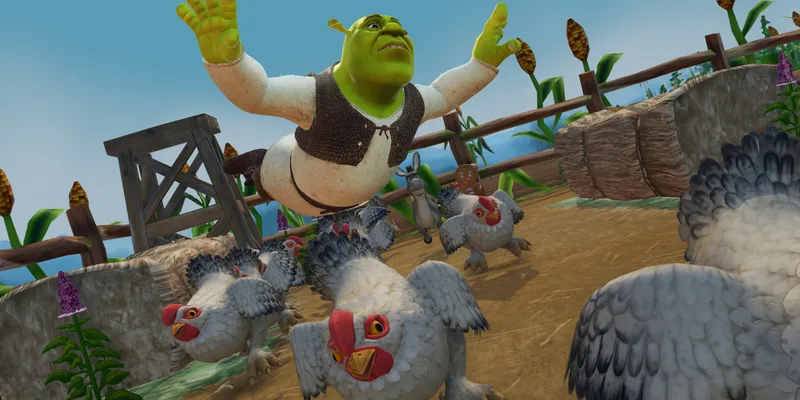
- Primary question: DreamWorks Shrek 2 Remastered may appear demanding because of its upgraded visual presentation.
- Confirmed upgrades: Improved textures, interface elements, cut scenes, and support for up to 4K resolution.
- Main factor: 4K output and enhanced assets can raise rendering and memory demands beyond the original release.
- Important limit: Official minimum and recommended PC specifications are not confirmed in the available announcement details.
- Best approach: Compare your PC against resolution, texture, and display targets rather than guessing from the title alone.
DreamWorks Shrek 2 Remastered Why Are the System Requirements So High?
The short answer is that a remaster can place much greater pressure on modern rendering hardware than the original game, even when the underlying adventure remains familiar. DreamWorks Shrek 2 Remastered is announced with improved textures, an upgraded interface, improved cut scenes, and support for resolutions up to 4K on compatible platforms.
Those changes do not automatically prove that the PC version has unusually high requirements. However, they explain why players may expect a larger graphics-memory footprint and more demanding rendering settings than the 2004 release. The available announcement information does not provide an official PC minimum or recommended specification list, so precise hardware conclusions would be premature.
The most important distinction is between the game itself and the settings used to display it. A PC targeting standard resolution may need considerably less power than one attempting 4K output with enhanced textures and high-quality effects.
| Confirmed feature | Likely PC impact | What remains unconfirmed |
|---|---|---|
| Improved textures | Higher texture memory use | Texture resolution tiers |
| Upgraded interface | More modern image assets | Interface performance cost |
| Improved cut scenes | Potentially larger video or scene assets | Whether scenes were fully remade |
| Up to 4K resolution | Greater GPU and display workload | PC-specific 4K presets |
| Photo mode | Additional image capture features | Capture resolution and effects |
| Four-player online support | Possible network and CPU overhead | Final PC networking requirements |
No official CPU, GPU, RAM, storage, or operating-system requirements are confirmed in the supplied announcement details. Treat exact hardware claims as provisional until the developer or storefront publishes them.
The phrase “high system requirements” may therefore describe expectations rather than a verified technical fact. A remaster can look demanding on paper because it advertises 4K support and modernized assets, while still scaling down effectively on mid-range computers.
Which Upgrades Can Raise PC Performance Demands?
Texture quality is usually the clearest reason a remaster needs more graphics memory. Original-era assets were designed around older display standards and hardware limitations. If character models, environments, menus, and effects receive higher-resolution texture treatment, the game may need to load more data into video memory.
Resolution is another major factor. Moving from a traditional display target to 4K increases the number of pixels the GPU must render. A 4K image contains four times as many pixels as a 1080p image, so a player seeking the highest output setting should expect a substantially heavier graphics workload.
Improved cut scenes are less straightforward. The announcement confirms that cut scenes are improved, but it does not explain whether this means higher-resolution video, refreshed animation, upgraded lighting, or a mixture of techniques. Each approach has different storage and performance implications.
Texture Upgrade
Higher-resolution surfaces can improve characters, environments, and objects while increasing video-memory use.
4K Output
A larger pixel count can place more load on the graphics processor, especially at higher-quality settings.
Modern Presentation
Refined menus, cut scenes, photo mode, and visual effects may add assets beyond the original release.
| Setting target | Expected workload | Practical interpretation |
|---|---|---|
| Standard resolution | Lower pixel workload | A sensible starting point for modest hardware |
| 1080p enhanced | Balanced workload | Useful target for many gaming PCs |
| 1440p enhanced | Higher GPU demand | Requires more headroom than 1080p |
| 4K enhanced | Highest listed resolution target | Best reserved for capable hardware |
| Photo mode capture | Variable | Depends on output resolution and effects |
The remaster’s new features are not all equally demanding. A cheat menu is unlikely to be a major performance concern. Photo mode may be more significant if it uses high-resolution captures, depth-of-field effects, or extra visual processing. Online co-op can also introduce networking requirements, but network connectivity is different from graphics performance.
When evaluating a PC, start with the resolution and quality target you actually want. A computer that struggles with 4K may still be suitable for a lower-resolution presentation.
The best interpretation is that the highest settings may be demanding because the remaster is designed to present a 2004 game with modern display expectations. That does not mean every player must use the highest preset.
How to Estimate Your PC Readiness Before Official Specs
Until official specifications are published, use a cautious assessment process. First, identify your monitor’s native resolution. If you use a 1080p display, there is little reason to plan around the maximum 4K target. If you use a 4K monitor or television, your GPU will have a more demanding goal.
Next, review your graphics card’s available video memory and generation. Enhanced textures can benefit from additional VRAM, but VRAM alone does not determine performance. The GPU’s rendering capability, driver support, and cooling also matter.
System memory and storage should be treated separately. RAM helps the operating system and game manage active data, while storage capacity determines whether the installation can fit. The available announcement does not confirm the final installation size, so avoid relying on unofficial numbers.
| Hardware area | Why it matters | What to check |
|---|---|---|
| GPU | Renders enhanced scenes and resolution output | Model, VRAM, driver support |
| CPU | Handles game logic, co-op activity, and background tasks | Generation, cores, sustained performance |
| RAM | Supports the game and other active applications | Installed capacity and available memory |
| Storage | Holds the installation and updates | Free space and drive health |
| Display | Determines the target resolution | 1080p, 1440p, or 4K |
| Network | Supports online multiplayer features | Stable connection and platform access |
Identify Your Display Target
Write down whether you normally play at 1080p, 1440p, or 4K. This is more useful than assuming the maximum supported resolution is required.
Check Your Graphics Hardware
Record your GPU model, VRAM, driver version, and current performance in other modern remastered or texture-heavy games.
Review CPU and RAM
Confirm that your processor and system memory have enough headroom for the game, the operating system, and online co-op background services.
Reserve Storage Space
Keep adequate free space available for the base installation, patches, and temporary files without relying on an unconfirmed size estimate.
Adjust After Launch
Begin with a moderate preset, test a representative scene, and raise texture quality or resolution gradually if performance remains stable.
A PC does not need to target 4K to enjoy the remaster. Start at a realistic resolution, verify stability, and increase visual settings one at a time.
This process avoids a common mistake: judging the entire game by its most demanding setting. The advertised 4K capability is a ceiling for compatible hardware, not a universal requirement for every PC player.
Recommended Settings Strategy for Launch Day
The most reliable launch configuration is a balanced preset rather than an immediate push for maximum quality. Begin at your display’s native resolution, use the default enhanced preset, and observe frame pacing during busy scenes, cut scenes, and multiplayer sessions.
If performance is inconsistent, reduce resolution or texture quality before changing every option at once. Resolution usually produces a visible performance difference, while texture quality may affect VRAM usage more than raw processing speed. Testing one setting at a time makes it easier to understand the source of a problem.
| Symptom | First adjustment | Reason |
|---|---|---|
| Low average frame rate | Reduce resolution or render scale | Lowers the number of pixels rendered |
| Stuttering during scene changes | Lower texture quality or close background apps | Reduces memory pressure |
| Stable performance but blurry image | Raise resolution before effects | Improves clarity with a focused change |
| Cut-scene hitching | Check storage and background processes | Asset loading may be affected |
| Online co-op instability | Check network quality first | Connection issues are not always GPU issues |
| Excessive heat or fan noise | Lower the preset and verify cooling | Reduces sustained hardware load |
For a 1080p monitor, prioritize consistent frame pacing and clear textures. For 1440p, use a balanced preset and leave room for multiplayer activity. For 4K, expect to make more deliberate compromises between resolution, texture quality, and effects.
Photo mode is best tested after the core game runs smoothly. It can be an enjoyable addition, but it should not determine your everyday graphics preset. Capture-focused settings may be suitable for screenshots while normal play benefits from a more stable configuration.
Online co-op can be affected by connection stability, platform services, and host conditions. Lowering graphics settings may help rendering performance, but it will not solve every networking problem.
The remaster also supports local couch co-op and online play for up to four players according to the announcement details. Mixed local and online co-op is highlighted as a feature, allowing players in one room to join with a remote friend. That feature may increase the value of a stable CPU, network connection, and consistent frame rate, but the final PC requirements remain to be confirmed.
Launch Checklist and Final Verdict
The available information supports a measured conclusion. DreamWorks Shrek 2 Remastered may have higher requirements than the original because it combines updated textures, improved presentation, modern interface assets, enhanced cut scenes, and support for up to 4K resolution. Those upgrades can increase the workload for graphics memory, rendering hardware, storage, and possibly scene loading.
However, there is no confirmed evidence in the supplied material that the PC version has unusually high minimum specifications. Until the official requirements are published, the most accurate answer is conditional: the highest visual targets may be demanding, while lower resolutions could be more accessible.
Pre-Launch PC Readiness:
- Confirm your monitor resolution and preferred image-quality target
- Record your GPU model, VRAM, CPU, RAM, and free storage
- Update graphics drivers before testing the remaster
- Plan to start with a balanced preset instead of maximum settings
- Check your wired or wireless connection for online co-op
| Question | Current answer |
|---|---|
| Are official PC requirements confirmed? | Not in the available announcement details |
| Is 4K supported? | Yes, on compatible platforms and hardware |
| Will every PC need to run 4K? | No, 4K is a supported target rather than a universal requirement |
| Could improved textures raise VRAM use? | Yes, that is a reasonable technical expectation |
| Does online co-op automatically require a powerful GPU? | No, networking and graphics performance are separate factors |
| Should players wait for final specifications? | Yes, if buying hardware specifically for this release |
Q: Why are the DreamWorks Shrek 2 Remastered system requirements expected to be higher than the original?
The remaster adds improved textures, an upgraded interface, improved cut scenes, and support for up to 4K resolution. These features can require more rendering power and graphics memory than the original presentation.
Q: Are the official minimum and recommended PC specifications available?
The supplied announcement details do not confirm official CPU, GPU, RAM, storage, or operating-system requirements. Players should wait for the developer or storefront listing before treating specific numbers as final.
Q: Do I need a 4K gaming PC to play DreamWorks Shrek 2 Remastered?
No. The announcement describes 4K as an available resolution on compatible platforms. Players can choose a lower resolution that better matches their display and hardware.
Q: Can a lower-resolution setup still benefit from the remaster?
Yes. Improved textures, interface updates, enhanced cut scenes, photo mode, and multiplayer features are not limited to players using the highest resolution target.
Do not upgrade your PC solely because the remaster advertises 4K support. Compare the final official requirements with your preferred resolution, then adjust settings around stable performance.
The practical verdict is straightforward: the remaster’s highest settings could be more demanding than the original game, but “high system requirements” should not be treated as confirmed until the official PC specification sheet arrives. For now, assess your setup by resolution, GPU capability, VRAM, CPU headroom, RAM, storage, and network quality rather than by the remaster label alone.